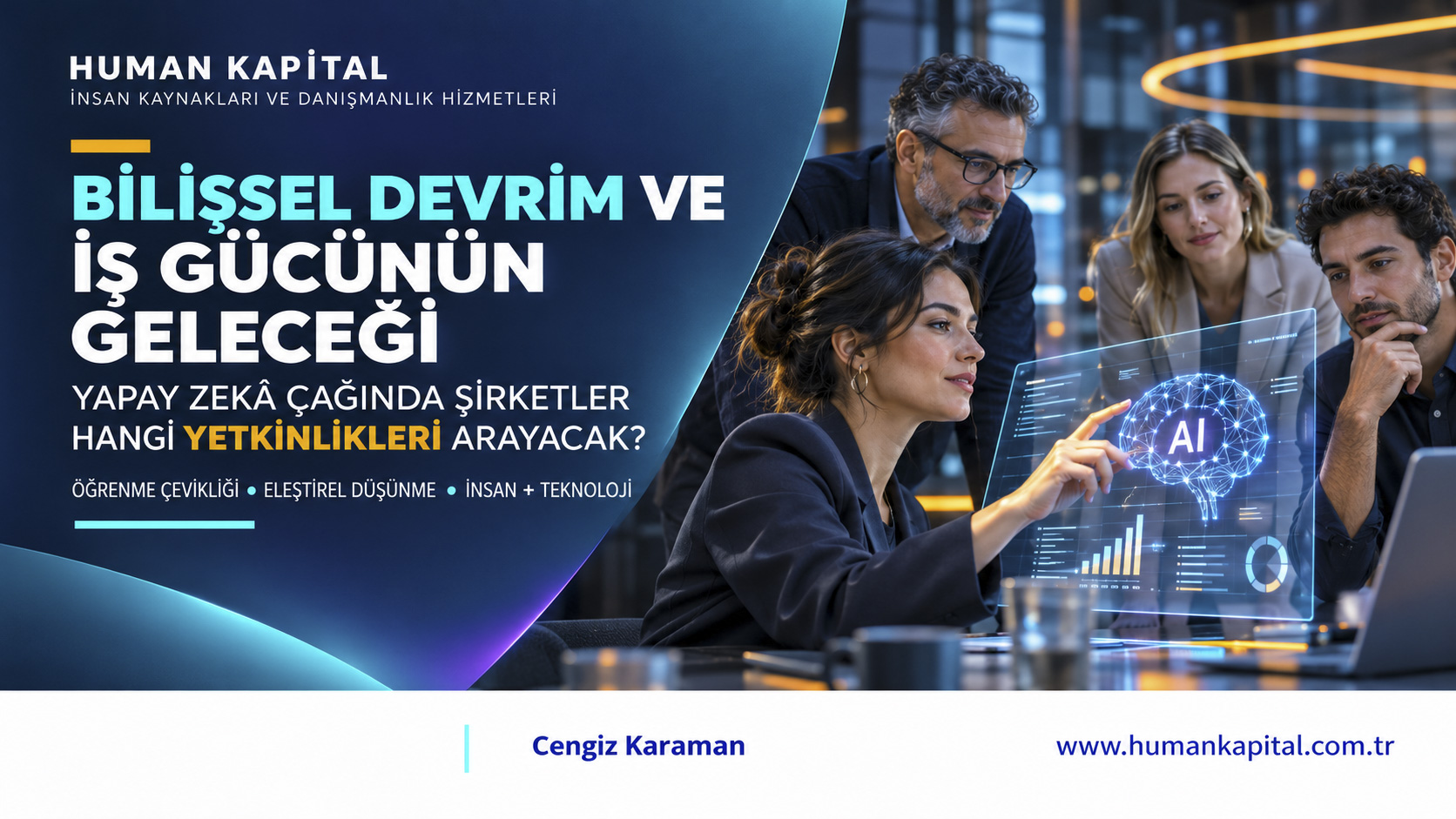
Artificial intelligence is not merely automating jobs. It is reshaping the nature of professions, employee roles, organizational structures, and the skills that create value in the business world. This transformation raises important questions about the future of human labor, the changing value of expertise, and how companies will build competitive advantage.
The Industrial Revolution transformed physical labor through machines. Today, we are experiencing a transformation of comparable magnitude, but unfolding at a much faster pace: the Cognitive Revolution.
In its article The Cognitive Revolution, published on September 2, 2026, Sequoia Capital examines this transformation from a historical perspective. Its central argument is that, just as the Industrial Revolution reduced the cost of physical labor, artificial intelligence will significantly reduce the cost of cognitive labor.
This perspective raises a critical question for the human resources and recruitment industry:
In the future, will companies compete for specific positions, or for specific skills and capabilities?
The answer could transform not only recruitment practices but also organizational design, career management, leadership models, and talent strategies.
1. Will Jobs Disappear or Be Redefined?
Discussions about AI's impact on employment often focus on which professions will disappear. However, this perspective overlooks a significant part of the transformation.
A profession consists of a combination of different tasks and competencies.
For example, a finance manager's responsibilities include financial reporting, budgeting, forecasting, risk analysis, strategic decision support, and stakeholder management.
AI may automate some of these tasks while improving managerial decision-making in others.
Similarly, an HR specialist may spend less time on operational reporting, résumé screening, and data analysis, while taking on greater responsibilities in employee relations, organizational development, and strategic advisory services.
Therefore, viewing this transformation solely in terms of disappearing professions is insufficient.
The fundamental transformation lies in how tasks within professions are redistributed and how the competencies required to perform them evolve.
This shift also has significant implications for recruitment.
While traditional recruitment focuses on the tasks candidates have performed in the past, future recruitment approaches will also need to assess their ability to take on evolving responsibilities.
2. Experience or Learning Agility?
Today, years of experience, industry background, and time spent in similar positions remain important evaluation criteria in many recruitment processes.
These factors will continue to matter, particularly in roles requiring technical expertise, regulatory knowledge, operational experience, and leadership.
However, as technological transformation accelerates, past experience may become a less reliable predictor of future performance in certain roles.
For example, a professional who has used a particular software application for many years may find that their advantage diminishes when AI-powered systems replace that application.
Conversely, employees who can quickly learn new technologies, apply existing knowledge to different problems, and redesign working methods may become increasingly valuable.
This is where learning agility will gain greater importance in talent assessment.
However, learning agility should not be viewed as an alternative to experience, but rather as a complementary competency that enables experience to remain valuable in the future.
Recruitment processes may increasingly focus on questions such as:
-
How has the candidate adapted to significant technological or organizational change?
-
What measurable business results have they achieved by learning a new skill?
-
Which processes have they improved by challenging existing working methods?
-
How have they made decisions under uncertainty?
-
What business outcomes could they improve by using AI and digital tools?
These questions aim to assess not only candidates' previous experience but also their potential to adapt to future changes.
3. Will Expertise Lose Its Value in the Age of AI?
One of the most important debates surrounding the Cognitive Revolution concerns the future economic value of expertise.
Easier access to information and AI's ability to perform certain analytical tasks may reduce the cost of some expert activities.
However, this does not mean that all forms of expertise will lose value.
Instead, the areas in which expertise creates value may change.
For example, preparing planning spreadsheets alone may no longer be sufficient for a production planning manager.
The ability to make sound decisions by simultaneously evaluating demand variability, production capacity, supply risks, and operational constraints may become increasingly important.
Similarly, a finance director's value may derive not simply from producing reports, but from connecting financial information to strategic decisions.
Three competencies stand out in this transformation:
Domain expertise: A deep understanding of the technical, industry-specific, and operational dynamics of the business.
Judgment and decision-making quality: The ability to critically evaluate AI-generated outputs, assess risks, and make sound decisions.
Ability to work with technology: Integrating AI systems into business processes to generate measurable results.
Therefore, the strongest professionals of the future may not simply be those who can use technology, but those who can combine domain expertise with technology to make better-informed decisions.
4. The Transformation of Management Roles: From Controlling Managers to Value-Creating Leaders
AI may affect not only specialist positions but also management structures.
In its article From Hierarchy to Intelligence, published on March 31, 2026, Sequoia Capital emphasizes that a significant portion of traditional organizational structures was developed to facilitate information flow and coordination.
In conventional organizations, managers collect information from their teams, evaluate it, communicate it to senior management, and coordinate the implementation of decisions.
However, as AI systems become capable of continuously analyzing operational data, certain reporting and coordination activities may be automated.
This does not mean that middle managers will disappear entirely.
It may, however, change where managers create value.
Future managers will be expected not only to oversee operations but also to develop employees, manage uncertainty, make strategic decisions, and establish effective collaboration between people and technology.
Consequently, management selection processes may increasingly consider additional indicators alongside traditional criteria such as team size and organizational authority.
For example:
-
Change and transformation leadership
-
Employee development and coaching capabilities
-
Data-driven decision-making
-
Cross-functional collaboration
-
Technology adaptability
-
Uncertainty and crisis management
Particularly in executive recruitment, organizations should assess not only how many people candidates have managed, but also how they have developed their teams' capabilities and led organizational transformation.
5. A New Recruitment Approach: From Position-Based to Skills-Based Hiring
Traditional recruitment processes are largely built around job descriptions.
Companies identify the position they need, define its responsibilities, and search for candidates who have previously performed similar tasks.
However, when the nature of work changes rapidly, fixed job descriptions may become outdated more quickly.
As a result, skills-based hiring is likely to become increasingly important in recruitment strategies.
This approach does not mean that academic qualifications or years of experience will become irrelevant.
Rather, the objective is to achieve a stronger alignment between candidates' capabilities and the current and future requirements of a role.
Consider a company seeking an operations leader to manage its digital transformation.
Having previously held the same job title may not be sufficient.
The candidate's ability to understand production processes, translate technology investments into operational outcomes, manage employees' adaptation to change, and coordinate different functions toward shared objectives may prove more decisive.
This perspective could influence multiple stages of executive search, from building candidate pools to designing interview methodologies.
The fundamental question in future recruitment will not simply be:
"Has this candidate done this job before?"
It will also be:
"Can this candidate create the value required by the evolving role?"
6. The Cognitive Revolution in Executive Search: From Research to Strategic Advisory
AI's impact on the recruitment industry is particularly significant for executive search firms.
Candidate sourcing, résumé screening, profile comparison, data collection, and preliminary assessment represent a substantial portion of the cognitive activities involved in recruitment.
As AI agents advance, certain stages of these activities may be completed faster and at a lower cost.
An example presented in Sequoia Capital's article 2026: This Is AGI illustrates this transformation.
In the article, an AI agent researches a technical leadership profile needed by a startup founder across different platforms, evaluates candidates' professional activities, and produces a shortlist of one candidate, along with a personalized outreach recommendation, within 31 minutes.
This example should be understood as a hypothetical scenario illustrating the potential of AI agents. Nevertheless, it offers an important perspective on which executive search activities may be transformed.
The critical distinction lies between accessing candidate information and accurately evaluating the right candidate.
Analyzing a candidate's career history, technical expertise, and professional activities may become increasingly straightforward.
However, understanding a candidate's genuine career motivations, assessing their interest in a new opportunity, managing compensation expectations, building trust, and successfully navigating complex career transitions require different capabilities.
Particularly in mid-level and executive recruitment, the process involves much more than identifying qualified candidates.
A candidate's position within their current organization, career aspirations, leadership approach, cultural fit, and openness to change must also be evaluated.
Therefore, rather than disappearing, the headhunter's role may be redefined as AI advances.
As technology makes candidate sourcing easier, the quality of advisory services may become a more important competitive differentiator.
In this transformation, executive search firms may strengthen their value proposition in three key areas:
Strategic talent advisory: Assessing not only a company's immediate hiring requirements but also the capabilities it will need in the future.
In-depth candidate assessment: Analyzing motivation, leadership, adaptability, and organizational context beyond technical qualifications.
Relationship and process management: Building trust between candidates and employers, managing expectations, and supporting sustainable hiring decisions.
AI can also provide support in these areas. However, human judgment, trust, and accountability will remain critical, particularly in high-impact hiring decisions.
Furthermore, AI systems used in recruitment will need to be carefully managed with regard to data privacy, discrimination risks, assessment transparency, and human oversight.
7. The Real Risk for Companies: Missing the Skills Transformation, Not the Technology
Discussions surrounding the Cognitive Revolution frequently emphasize corporate investment in technology.
However, purchasing technology does not automatically guarantee organizational transformation.
A company may have access to advanced AI systems.
Yet if its employees lack the capabilities to use these systems, managers do not support change, or business processes are not redesigned, the expected productivity improvements may not materialize.
Therefore, AI transformation is also a transformation of people and organizations.
Companies need to address several fundamental questions:
-
Which tasks within our existing positions are suitable for automation?
-
Which competencies will become strategically more important?
-
Which employees can be prepared for different roles through reskilling programs?
-
Which positions will require external talent acquisition?
-
Are our management selection processes aligned with the organizational structures of the future?
-
Do our recruitment processes measure past experience or the capacity to create future value?
The answers to these questions should be part of the strategic agenda not only of HR departments but also of senior leadership.
8. Conclusion: The Future Belongs to Companies That Can Redefine Talent
The Industrial Revolution transformed how physical work was performed.
The Cognitive Revolution is reshaping how cognitive work is carried out.
However, this transformation is unlikely to affect every profession in the same way.
Some tasks will be automated.
The responsibilities within certain professions will change.
New areas of expertise and working models will emerge.
In this environment, companies' competitive advantage will not depend solely on their access to AI technologies.
The real difference will be created by organizations capable of integrating technology into business processes, developing their employees' competencies, and attracting talent aligned with future requirements.
A similar transformation is taking place in the executive search industry.
In the future, the value of successful recruitment advisory services may no longer be measured primarily by the ability to reach candidates.
Accurately analyzing companies' evolving talent requirements, assessing potential, understanding human behavior, and contributing to strategic hiring decisions may become increasingly important.
Because in the age of AI, the fundamental challenge is no longer simply about placing the right person in the right position.
It is about connecting the right talent with organizations prepared for the future of work.
References
-
Buhler, K. (2026, September 2). The Cognitive Revolution. Sequoia Capital. https://sequoiacap.com/article/the-cognitive-revolution
-
Botha, R., & Dorsey, J. (2026, March 31). From Hierarchy to Intelligence. Sequoia Capital. https://sequoiacap.com/article/from-hierarchy-to-intelligence
-
Grady, P., & Huang, S. (2026, January 14). 2026: This Is AGI. Sequoia Capital. https://sequoiacap.com/article/2026-this-is-agi
Have a critical role to fill?
Share your role and we'll present a qualified shortlist within 5-10 business days.