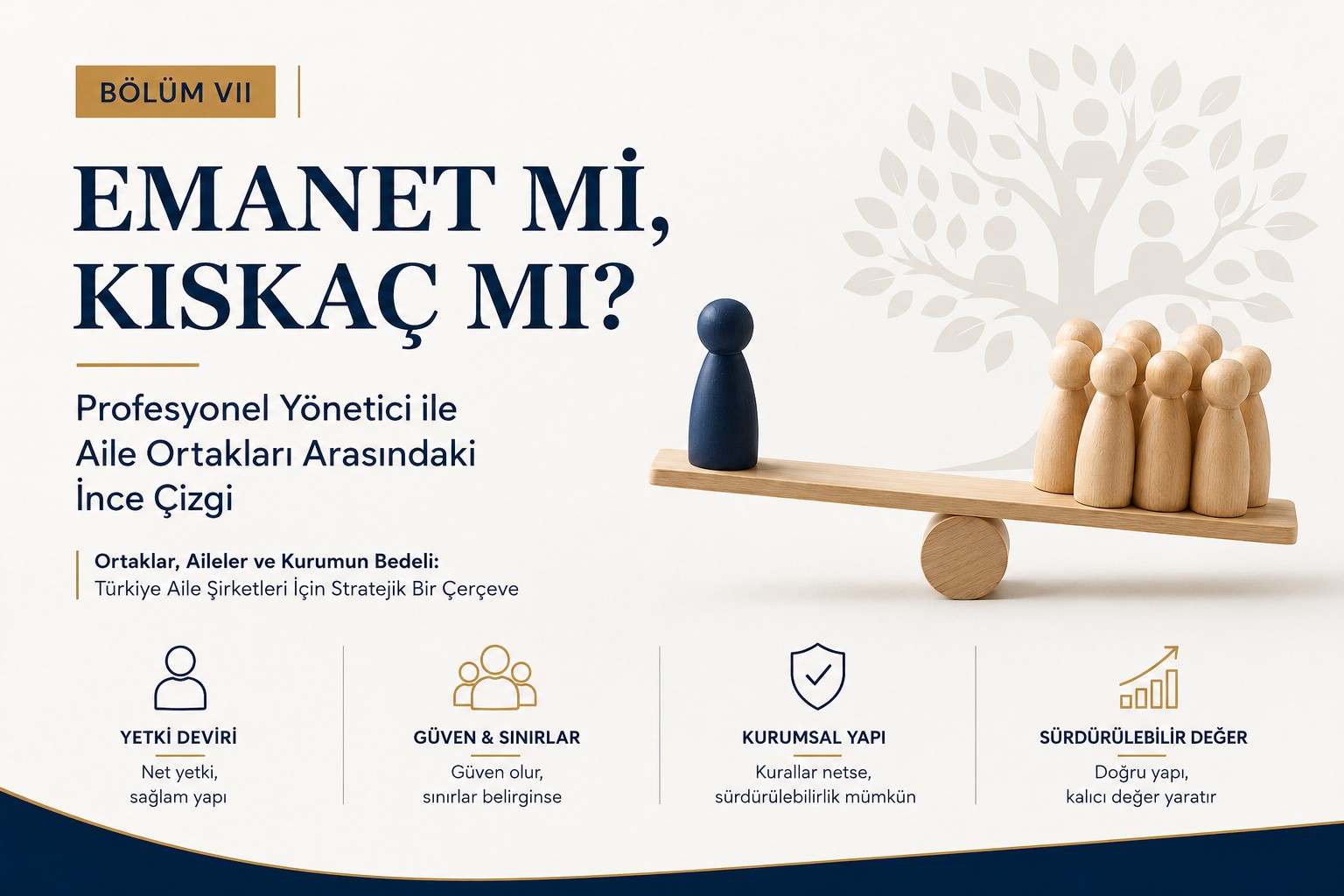
SECTION VII: Entrusted or Entrapped?
The Fine Line Between Professional Management and Family Shareholders
The Cost to Partners, Families and the Institution:
A Strategic Framework for Family Businesses in Türkiye
As a family business grows, it inevitably reaches a transition point: family members can no longer manage every department, every process and every relationship themselves. The scale of the company makes specialized professional roles necessary. At that point, the company brings in an external professional executive.
On paper, this is the right decision. In practice, however, in many family businesses this moment marks the beginning of a new crisis. Because the professional executive is hired, but never truly allowed to manage independently.
|
THE FUNDAMENTAL PARADOX |
|
A family business needs professional management in order to grow. But fully empowering a professional executive means relinquishing a degree of control. For the family, relinquishing control is not merely a business issue; it is also an issue of identity. Unless this paradox is resolved, even the best executive will soon either adapt to the system or leave. Both outcomes weaken the company. |
To understand this tension, one perspective is not enough. The same dynamic must be examined through three different lenses — that of the professional executive, the family shareholder and the employees.
The Anatomy of Tension from Three Perspectives
Professional Executive — General Manager / C-Suite
|
What Do They Experience? |
What Is the Result? |
|
Authority appears to have been delegated, yet every critical decision still requires approval from a family member. |
The executive either adapts to the system and compromises professional standards, or eventually leaves. |
|
They are responsible for employees, but ultimately accountable to the shareholder. |
If they accept that “this is simply how things work here,” efficiency declines. |
|
They create strategic plans, but a shareholder may change them at any time. |
The executive’s strategic contribution becomes increasingly limited. |
|
Decisions taken in meetings are overturned in corridors. |
Management authority and confidence in decision-making deteriorate. |
|
They are caught between “you were hired because we trust you” and “every step you take is monitored.” |
Both scenarios weaken the company. |
Family Shareholder / Family Member on the Board
|
What Do They Experience? |
What Is the Result? |
|
They built the company from the ground up; “entrusting” it to someone else can feel like losing part of their identity. |
Well-intentioned interventions gradually begin to erode the professional executive’s authority. |
|
They trust the executive, but believe that if something goes wrong, they themselves will ultimately be held responsible. |
They struggle to relinquish control completely. |
|
They are often unaware of how frequently they intervene; each intervention feels like “a small correction.” |
Intervention stops being an exception and turns into a management style. |
|
They do not recognize that they are undermining the executive’s authority because their intentions are positive. |
Employees learn who the “real boss” is. |
|
They see the message “I am still here” as a sign of ownership and care rather than distrust. |
The professional executive gradually becomes a figurehead. |
Employees and Middle Managers
|
What Do They Experience? |
What Is the Result? |
|
They do not know whom to follow: the professional executive or the shareholder. |
Organizational commitment declines. |
|
They receive two different instructions on the same issue. |
Decision-making and execution slow down. |
|
Career paths become unclear: is advancement determined by merit or closeness to the family? |
The performance culture weakens. |
|
They learn that the safest strategy is to wait, choose sides and remain invisible. |
Taking initiative becomes risky. |
|
They fear the consequences of having listened to the “wrong person.” |
Efficiency gives way to a survival instinct, creating a silent organizational paralysis. |
Dynamics Specific to Türkiye
This tension exists in family businesses around the world. However, cultural and structural characteristics specific to Türkiye can deepen the problem further.
|
Dynamic |
Organizational Impact |
|
Trust Culture and the “One of Us” Norm |
In Turkish business culture, trust is often placed in individuals rather than institutions. An “outsider” may initially be perceived as a potential threat. No matter how successful the executive is, being outside the family can create a glass ceiling. |
|
Hierarchy and Age Factor |
A young but capable executive may experience cultural pressure when defending ideas against an older shareholder. The norm of “respecting elders” can suppress constructive corporate debate. |
|
Lack of Written Authority Boundaries |
When the executive’s authority limits are not documented, every disagreement creates a new area of uncertainty that must be renegotiated. |
|
The Symbolic Role of the Board of Directors |
In many family businesses, the board exists primarily as a legal requirement while real decisions are taken elsewhere. This simultaneously weakens the authority of both the professional executive and the board. |
Global Examples — The Same Crisis at Different Scales
|
Company / Country |
Structure and Tension Experienced |
Core Lesson |
|
Ford — USA |
In the 1990s, the Ford family appointed professional CEOs to support the company’s growth. Heavy intervention from the family-controlled board was followed by Jacques Nasser’s departure in 2001, after which William Clay Ford Jr. became CEO. |
When authority is delegated only halfway, even the best executive may appear to fail. |
|
Samsung — South Korea |
The Lee family created an informal layer of control above the formal management structure. Professional executives held senior positions, but strategic decisions remained subject to family approval. |
Informal control can make an organization both powerful and fragile. |
|
Walmart — USA |
The Walton family remained the largest shareholder while delegating management to professional executives. The family exercised influence through the board rather than direct operational involvement. |
Separating control from management protects both the family and the company. |
|
Koç Holding — Türkiye |
The Koç family continued to provide strategic direction through the board while leaving day-to-day management to professional executives. |
Institutionalization does not weaken family values; it creates a structure capable of carrying those values across generations. |
|
GOLD STANDARD — SEPARATING CONTROL FROM MANAGEMENT |
|
The common denominator among successful family businesses worldwide is this: the family determines the strategic direction and retains ownership, while the professional executive manages operations with full authority within that framework. When these two roles overlap, both become dysfunctional. When they are separated, both become stronger. |
How the Board of Directors Should Function — Five Fundamental Principles
|
No. |
Fundamental Principle |
Application |
|
01 |
Authority boundaries must be clearly documented |
Which decisions can the executive make independently? Which decisions must go to the board? Which issues belong to the family council? Unless these boundaries are written down, every decision can turn into a dispute. |
|
02 |
At least one independent board member is essential |
A board made up entirely of family members can become an extension of family dynamics. An independent member provides both legitimacy and an objective point of reference. It is critical that this person be genuinely independent — not simply a family friend. |
|
03 |
A board meeting is a decision-making meeting — not an information meeting |
The board should function as the genuine decision-making body. Decisions should not already have been made informally before the meeting. |
|
04 |
The CEO should be evaluated by criteria, not by family preference |
The professional executive’s performance should be assessed against predetermined corporate criteria. “Shareholder satisfaction” alone is not a valid performance measure. |
|
05 |
Corridor decisions should be treated as outside the rules |
Instructions given to executives through phone calls, messages or informal conversations systematically weaken management authority. Corporate decisions should be made through corporate mechanisms. |
Comparison: Entrapment Structure vs. Entrustment Structure
|
Dimension |
Entrapment Structure |
Entrustment Structure |
Organizational Impact |
|
Authority boundaries |
Not documented; change depending on circumstances |
Clear, documented and accepted by all parties |
Predictability |
|
Decision-making process |
Decisions taken in meetings are overturned informally |
Decisions are made and implemented through formal corporate mechanisms |
Reliability |
|
Executive tenure |
Short — the executive either adapts or leaves |
Longer — growth and contribution develop together |
Institutional Memory |
|
Employee behavior |
Choosing sides, waiting, remaining invisible |
Taking initiative, developing and building commitment |
Performance Culture |
|
Board of Directors |
Symbolic; decisions have already been made elsewhere |
Functional; a genuine decision-making body |
Corporate Legitimacy |
|
Company value |
Identified with the founder and difficult to transfer |
Embedded in institutional memory and sustainable |
Enduring Value |
Core Insight
|
DELEGATING AUTHORITY TO A PROFESSIONAL EXECUTIVE DOES NOT MEAN LOSING THE COMPANY. |
|
On the contrary, it means building a structure capable of keeping the company standing even when the founder is no longer present. Real control does not come from being involved in every decision — it comes from having built the right structure. Family businesses that understand this can survive across generations. Those that do not often fade together with the founder. |
Have a critical role to fill?
Share your role and we'll present a qualified shortlist within 5-10 business days.