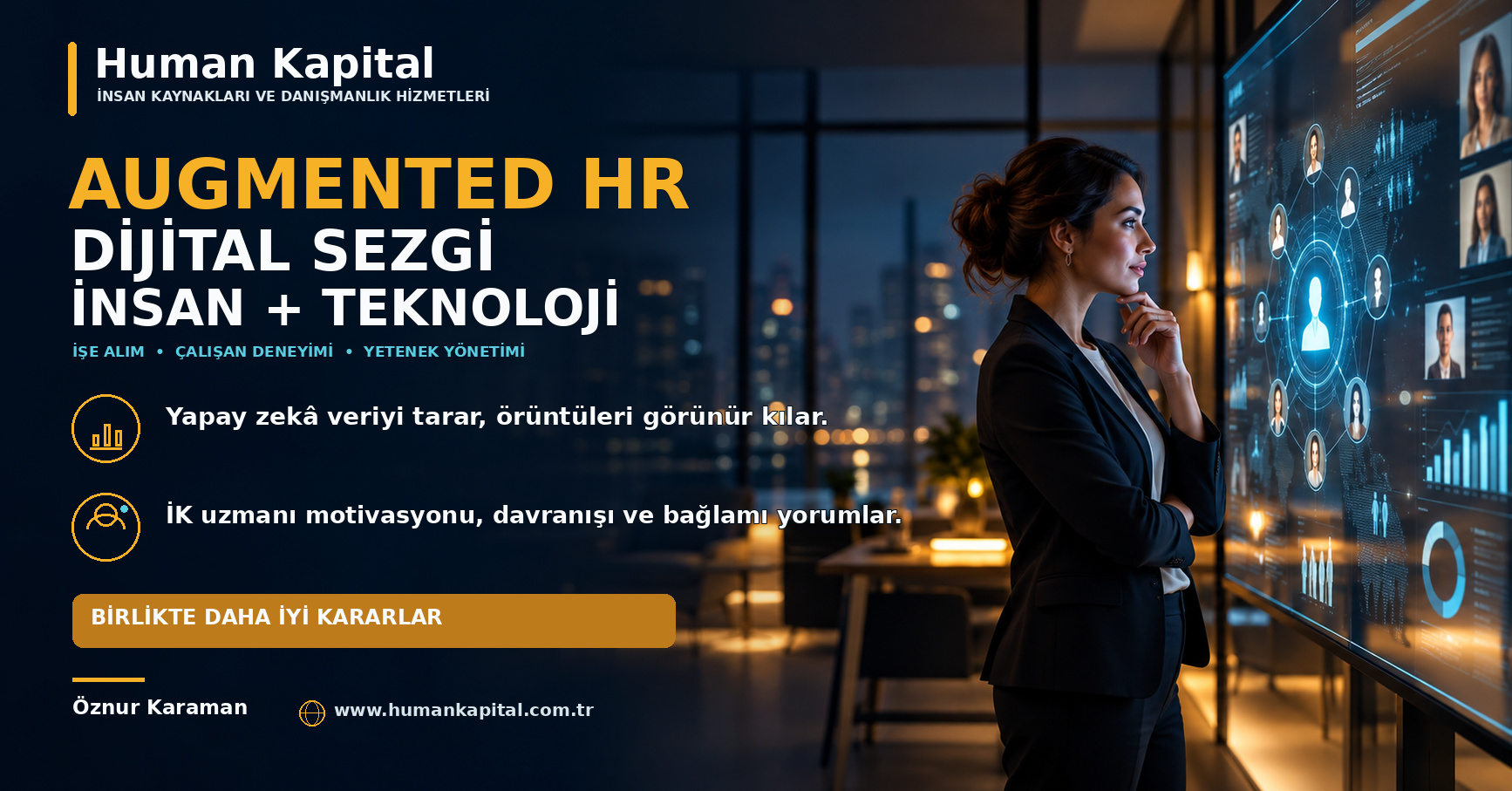
The development of artificial intelligence and digital technologies is significantly changing the way human resource management operates. In particular, the integration of artificial intelligence, people analytics, predictive analytics, and automation tools into HR processes is transforming not only the operational duties of HR professionals but also their decision-making processes. Kalff and Simbeck’s (2026) study of companies in Germany also notes that artificial intelligence has both an automation effect and an augmentation effect on HR processes. In this context, Augmented HR can be considered an approach in which technology supports HR professionals’ knowledge, experience, intuition, and decision-making capacity, rather than replacing them.
One of the important elements of the Augmented HR approach is the concept of digital intuition. In traditional HR practices, professional intuition plays an important role in areas involving significant human behavior, such as recruitment, talent management, and employee relations. An experienced HR specialist can assess a candidate not only on the basis of the information in their résumé, but also by considering their choice of words during an interview, communication style, motivation, career preferences, and behavior. For example, a candidate may technically meet all the requirements of a position. However, during the interview, the recruiter may observe that the candidate has little motivation for the role or may not be suited to its working conditions in the long term. This assessment relies on the human capacity to interpret behavior and context.
Digital intuition refers to supporting this human assessment with information provided by data and artificial intelligence. For example, during a company’s recruitment process, artificial intelligence can analyze hundreds of résumés against criteria such as education, experience, industry, competencies, and career history, and identify suitable candidates. This can enable the recruiter to focus on a smaller, more relevant candidate pool instead of manually reviewing hundreds of résumés. However, artificial intelligence does not replace the recruiter. The recruiter combines the data obtained through technology with their own professional judgment by considering the candidate’s interview performance, motivation, communication style, the requirements of the position, and the company culture together. Therefore, the fundamental question in Augmented HR is not “humans or artificial intelligence?” but rather “how can humans and artificial intelligence make better decisions together?”
This approach can also be seen in employee engagement processes. For example, employee engagement surveys may show that satisfaction in a particular department has declined recently. People analytics tools can reveal this change and identify which employee groups are most affected. However, to understand why the data shows this result, an HR professional needs to speak with employees and assess the organizational context. These conversations may reveal that the problem is related to a manager’s communication style, increased workload, or insufficient career development opportunities. In this example, technology shows where the problem lies and what pattern has emerged, while the human factor helps explain why the problem occurred and how it affects employees.
Digital intuition can similarly be applied to talent management. For example, an analysis of promotion processes for high-performing employees in an organization may show that some employees have not advanced to leadership positions despite their strong performance. Data analytics can reveal this pattern. The HR professional can then investigate its causes by considering qualitative information such as performance results, managers’ feedback, employees’ career goals, and competency assessments. This makes it possible to seek answers not only to the question “Who is performing well?” but also to “Under what conditions can each employee develop, and what talent will the organization need in the future?”
Kalff and Simbeck’s (2026) study shows that the use of artificial intelligence in HR should not be viewed solely as replacing employees or fully automating tasks. The study emphasizes that automating repetitive, low-value tasks can give HR professionals more time for interpersonal interaction, strategic planning, and people-centered activities. At the same time, the researchers point out that the use of artificial intelligence also raises important issues, including data governance, algorithmic transparency, and ethics. For this reason, HR professionals need to critically assess the results produced by digital tools rather than accept them directly and without question.
In conclusion, Augmented HR can be considered an approach that enhances people’s decision-making capacity through technology rather than eliminating the human factor from HR. Digital intuition refers to bringing together people’s experience, intuition, and capacity for socio-emotional assessment with the information provided by artificial intelligence and data analytics. In the future, it will be important for HR professionals not only to use digital tools but also to interpret the data they provide within the context of human behavior and the organization. For this reason, digital literacy, analytical thinking, understanding human behavior, and digital intuition should be considered together among the competencies required of future HR professionals.
Have a critical role to fill?
Share your role and we'll present a qualified shortlist within 5-10 business days.