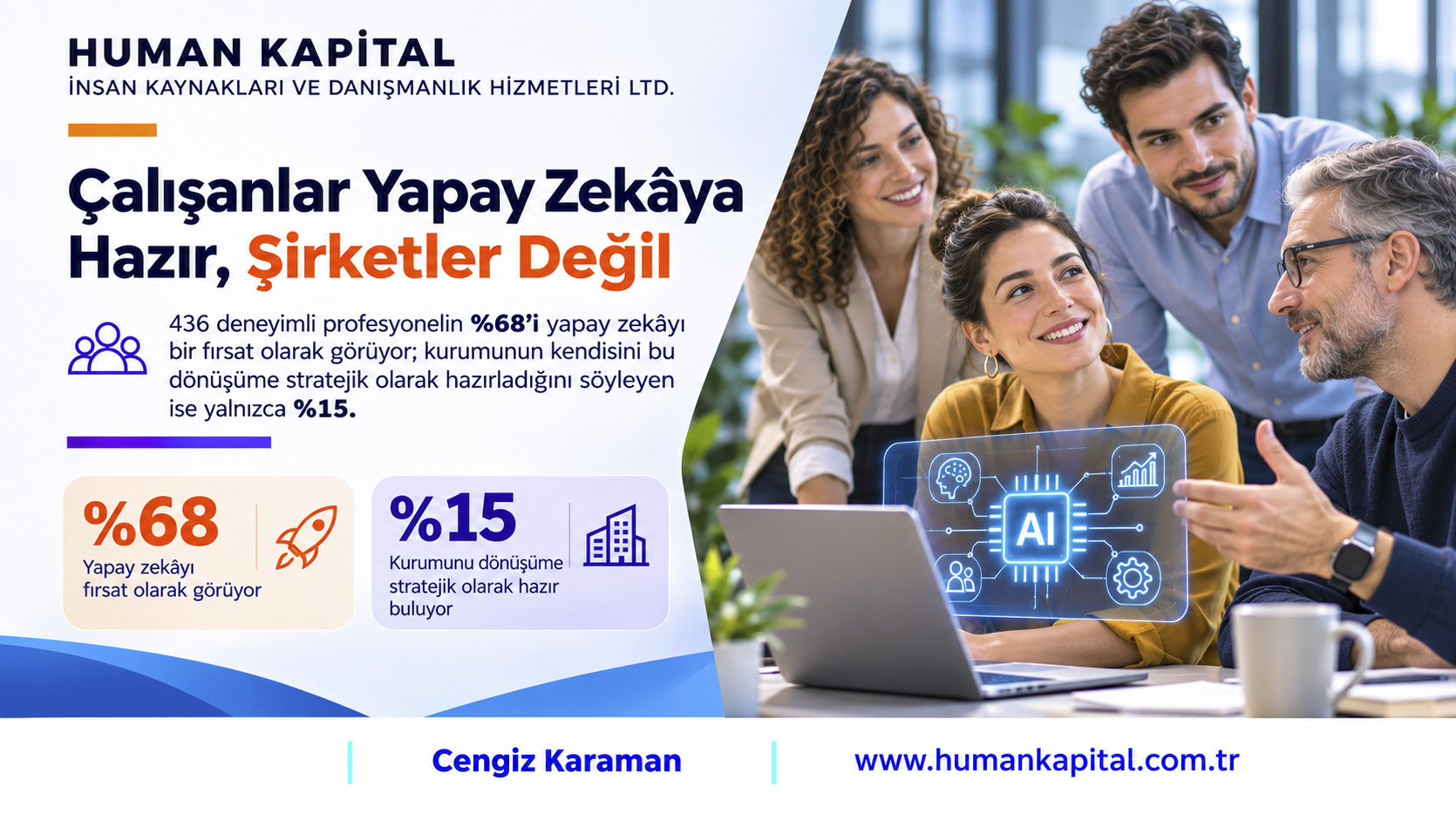
In the AI transformation, the real resistance is not coming from employees. 68% of 436 experienced professionals see AI as an opportunity, yet only 15% say their organisation is strategically preparing them for this shift.
For years we have heard the same line: "Employees resist change." When it comes to AI, our data says the opposite. Employees are willing, curious and ready; the side that is waiting, undecided and falling behind is the organisation itself.
In this article we use the data to show where this gap is deepest, whom it affects most and what it costs companies. The short answer: an unprepared organisation falls behind not only in technology, but also in retaining its most motivated employees.
The data: demand is with employees, supply is missing
Employees' view of AI is overwhelmingly positive: 68% see it as a partner that will make their work more creative and productive, and another 18% know their role will evolve and are focusing on gaining new skills. Only 3% see AI as a threat.
On the organisational side, the picture is very different. 34% of respondents say adapting to the transformation is "entirely my own responsibility", and 31% say their organisation has "no noticeable preparation". 20% say tools are arriving but training support is limited. Only 15% say their organisation anticipates their development needs and offers concrete programmes.
The most striking point: two thirds (67%) of those who see AI as an opportunity describe their organisation as either unprepared or leaving everything to their own efforts. The figure is the same among those who choose AI as their top development area. The most motivated employees are the ones receiving the least support.
Optimism at the top, anxiety below
Views on AI change as you move down the hierarchy. 78% of senior executives and C-level leaders see AI as a strategic opportunity. Among specialists and engineers this drops to 44%, and 38% of this group either see AI as a threat or cannot yet tell how it will affect their work.
Anxiety also shapes goals. 69% of senior executives choose AI as their top development area for the next one to two years; among specialists and engineers the figure is 35%. The group whose roles will be most affected by AI is the one planning to invest in it the least. 46% of this group describe their organisation as "traditional and inadequate" in the transformation.
Here is the paradox: senior executives believe in AI the most, yet only 12% of them find their organisation strategically ready for the transformation. The organisations they call unprepared are, to a large extent, run by them. The belief is there; the execution is not.
The difference is in the institution, not the mindset
Optimism about AI does not differ significantly by the ownership structure of the employer. Whether they work in a family company or a multinational, employees largely see AI as an opportunity. What differs is how the organisation responds to that demand.
The picture is especially striking in family and group companies, where more than half of respondents work. Only 10% of their employees find their organisation strategically ready for the transformation. 37% say their organisation has no noticeable preparation, and another 37% say everything is left to their own efforts. In other words, three quarters of family company employees are on their own in the transformation.
For family companies, the backbone of the Turkish economy, this is a warning. The employees' will is already there; what is missing is the organisational resolve to turn that will into a plan.
The cost of the readiness gap
An organisation's approach to transformation is not just a training issue; it shapes how employees see the organisation as a whole. The gap between those who find their organisation "strategic and developmental" and those who find it "traditional and inadequate" is one of the sharpest divides in the survey.
Three things stand out:
- Psychological safety doubles. In strategic organisations, 81% of employees feel they can voice their ideas without fear; in traditional ones, 41%. The organisation that invests in the future also builds a more open culture today.
- Wellbeing differs tenfold. In traditional organisations, only 5% of employees feel their wellbeing is genuinely valued; in strategic ones, 53%.
- Irreversible departures rise. 37% of those who find their organisation traditional and inadequate say "my decision is final" when they receive an offer; in the other groups the figure is 23%. The unprepared organisation loses even the chance of a counteroffer.
Not investing in the AI transformation is therefore not just a technology decision; it is a retention decision.
Five steps for leaders
- Own the demand. More than half of your employees want to build AI skills. Rather than leaving this to individual effort, turn it into an organisational development plan.
- Do not stop at handing out tools. 20% of respondents say their organisation brings in new tools but does not support individual development. Buying licences is not transformation; people learning how to bring those tools into their work is.
- Look for anxiety at the bottom of the hierarchy. Optimism in the boardroom does not reveal the anxiety of specialists and engineers on the ground. Talk openly with the people whose roles will change and bring them into the transformation.
- Close the gap between belief and execution. 78% of senior executives believe in AI, yet only 12% find their organisation strategically ready. The people who can close this gap are those same executives.
- See transformation as a retention strategy. Those who find their organisation unprepared are more certain about leaving. Investing in development is the most concrete way to keep your most motivated employees.
Final word
The biggest risk in the AI transformation is not that employees are unprepared; it is that prepared employees are kept waiting. And talent that is kept waiting eventually starts looking for an organisation that will not keep it waiting.
Who is leading the AI transformation in your organisation: the organisation itself, or employees' own efforts?
Method note: The data comes from a survey answered between January and November 2026 by 436 professionals, most of them middle and senior managers. 405 people answered the question on their organisation's approach to transformation. Differences by position and ownership structure are statistically significant (p<0.05);
Have a critical role to fill?
Share your role and we'll present a qualified shortlist within 5-10 business days.