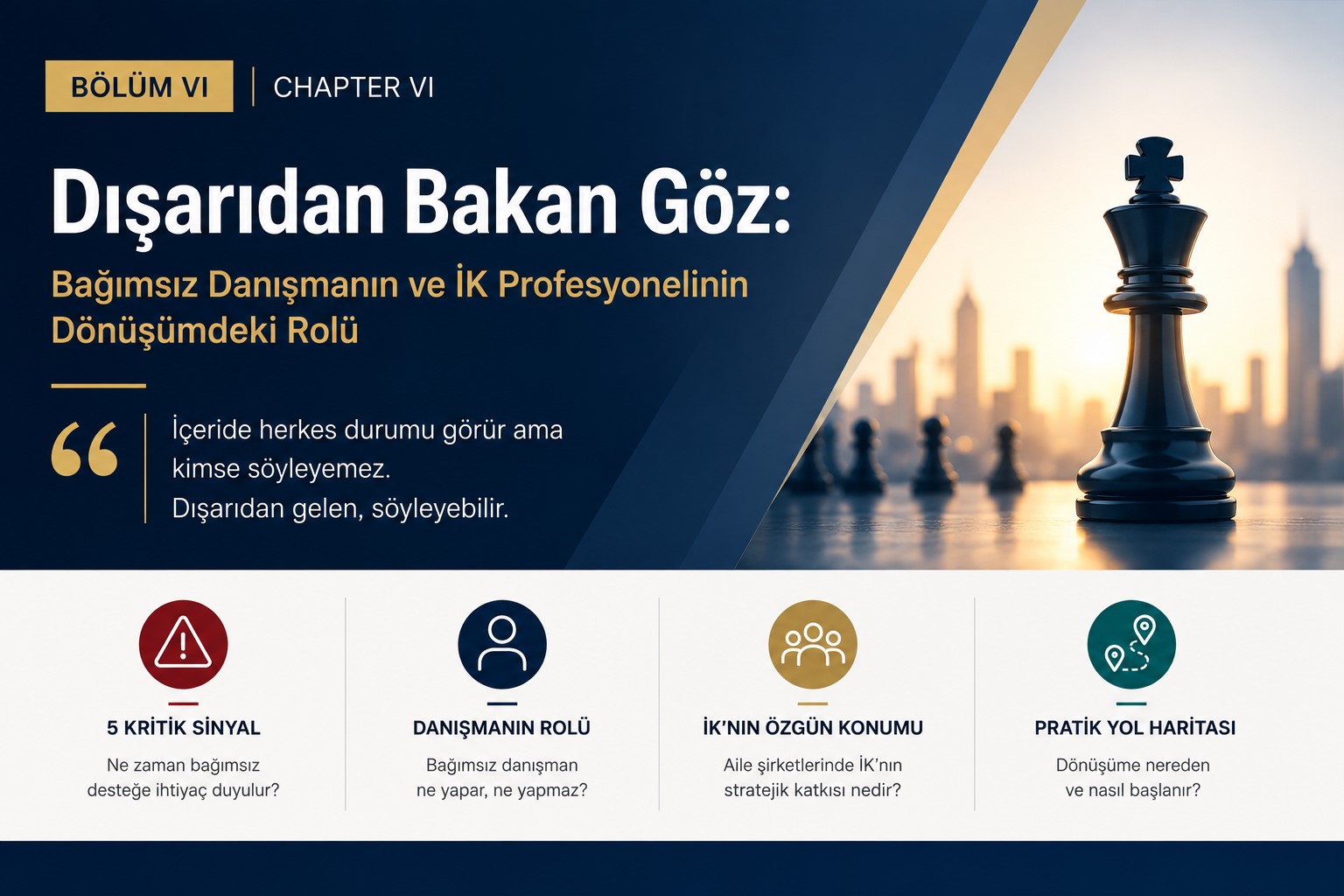
CHAPTER VI
The Outside Eye:
The Role of Independent Consultants and HR Professionals in Transformation
The previous chapters of this analysis have repeatedly revealed one reality: most crises in family businesses cannot be seen clearly from within. Even when they are seen — and they often are — they cannot be voiced. And even when they are voiced, action cannot always be taken. The reason is not a lack of knowledge; it is the weight of relationships.
Being unable to tell a sibling, “your management approach is weakening the company,” a father, “this decision is strategically wrong,” or a spouse, “your role in the company is undefined, and this ambiguity is paralyzing the organization” — these are not signs of weakness; they are human realities. Yet these realities often leave the organization paying the price. This is precisely where an outside perspective becomes critical.
Everyone inside can see the situation, but no one can say it. An outsider can — because they have no relationship to lose, but a perspective to contribute.
ON CORPORATE CONSULTING AND FAMILY BUSINESSES
The value of an independent consultant and HR professional does not come from “knowing the solution,” but from asking the right questions and making unspoken realities visible in a safe environment. This is not mediation; it is holding up a mirror to the organization.
WHEN SHOULD INDEPENDENT SUPPORT BE BROUGHT IN?
Five Critical Signals
IF EVEN ONE OF THESE SIGNALS EXISTS, INDEPENDENT SUPPORT SHOULD NO LONGER BE POSTPONED
01 — Partner meetings are no longer productive, but positional
Decisions are no longer being made in meetings; instead of trying to persuade one another, the parties are trying to prove themselves right. The agenda does not change, and the spiral deepens.
02 — Talented employees leave without asking
Exit interviews may cite “a better opportunity,” but the real reason is often that employees have recognized the tension among partners and see no room for growth within such uncertainty. The most capable employees leave first — because they have alternatives.
03 — Succession is no longer something that “will happen”; it is something that “must happen”
The founder has effectively stepped back due to health, age, or declining motivation, yet the formal transfer of leadership has not taken place. Every additional month of uncertainty makes the situation more costly.
04 — Financial decisions are moving away from transparency
Budget meetings are either not held or take place without all partners participating. Profit distribution is postponed with “let’s leave it until next time.” Financial information becomes asymmetrically distributed.
05 — The next generation “wants the company but does not accept the conditions”
The second generation wants to join the company, but the existing structure does not provide them with genuine leadership space. If this conflict remains unresolved, either the strongest members of the next generation build their lives elsewhere, or a silent management struggle begins within the company.
WHAT DOES AN INDEPENDENT CONSULTANT DO — AND NOT DO?
|
DOES |
DOES NOT |
|
→ Makes unspoken realities visible in a safe environment |
× Does not take sides — is not any partner’s advocate |
|
→ Facilitates family constitution and partner alignment processes |
× Does not make management decisions — facilitates them |
|
→ Customizes the institutionalization roadmap to the company’s dynamics |
× Does not provide legal mediation — provides organizational structuring |
|
→ Builds HR systems (performance, career, compensation) based on merit |
× Does not repair family relationships — clarifies institutional relationships |
|
→ Structures and manages succession planning |
× Does not offer one-size-fits-all solutions — creates a framework specific to each family business |
|
→ Becomes an objective reference point trusted by all parties |
× Does not wait for a crisis — preventive intervention is the most valuable intervention |
THE UNIQUE ROLE OF HR IN FAMILY BUSINESSES
In family businesses, HR professionals occupy a far more complex position than they do in conventional organizations. They must continuously balance protecting employees’ rights with preventing conflicts among partners from spilling over into the organization. This balance is possible only when HR reports directly to the board, operates independently, and has clearly defined boundaries of authority. In structures where HR becomes the “arm” of one partner, employees, the organization, and ultimately that partner all lose.
The HR professional’s most critical contribution in a family business is building institutional memory. Job descriptions, performance criteria, career paths, and compensation bands cannot be managed on the assumption that “we already know these things.” Unless they are documented and systematized, the company is forced to start from scratch whenever there is a change among partners, a generational transition, or a crisis.
At the same time, HR directly manages the channel through which conflicts among partners affect employees. How information is communicated, how decisions are explained, and how employees are treated during periods of uncertainty are among the primary factors determining how the company will emerge from such periods.
THE RIGHT TIME FOR TRANSFORMATION
Family businesses generally seek corporate consulting after a crisis has already erupted. Yet the most effective intervention is preventive work undertaken before the crisis. A structure established while trust still exists among partners costs far less than one built after that trust has been damaged. For a family business, seeking independent consulting support is not a sign of weakness — it is a sign of foresight.
WHERE TO START?
Practical Roadmap
FOUR-STEP STARTING FRAMEWORK
01 — DIAGNOSIS
An organizational health assessment conducted with an independent consultant. The current structure, relationship patterns, and areas of risk are mapped objectively. Without the parties being present together, but with input from all parties.
02 — ALIGNMENT
A facilitated vision and expectation session bringing together the partners and key family members. The purpose is not to make decisions, but to listen to one another. In many family businesses, this becomes the first meeting in which genuine listening actually takes place.
03 — STRUCTURING
The family constitution, governance structure, HR systems, and profit-sharing model are established step by step. Every step is approved, documented, and implemented. This phase can take between six months and two years.
04 — SUSTAINING
Annual review, adaptation to changing conditions, and updating institutional memory. The structure is a living framework; it is not something created once and placed on a shelf, but something that evolves together with the growing company.
Looking for a new role?
Become a member and let your profile be considered for new opportunities among our 50,000+ evaluated candidates.