Section V
Reactive or Strategic? Two Different Futures for Family Businesses
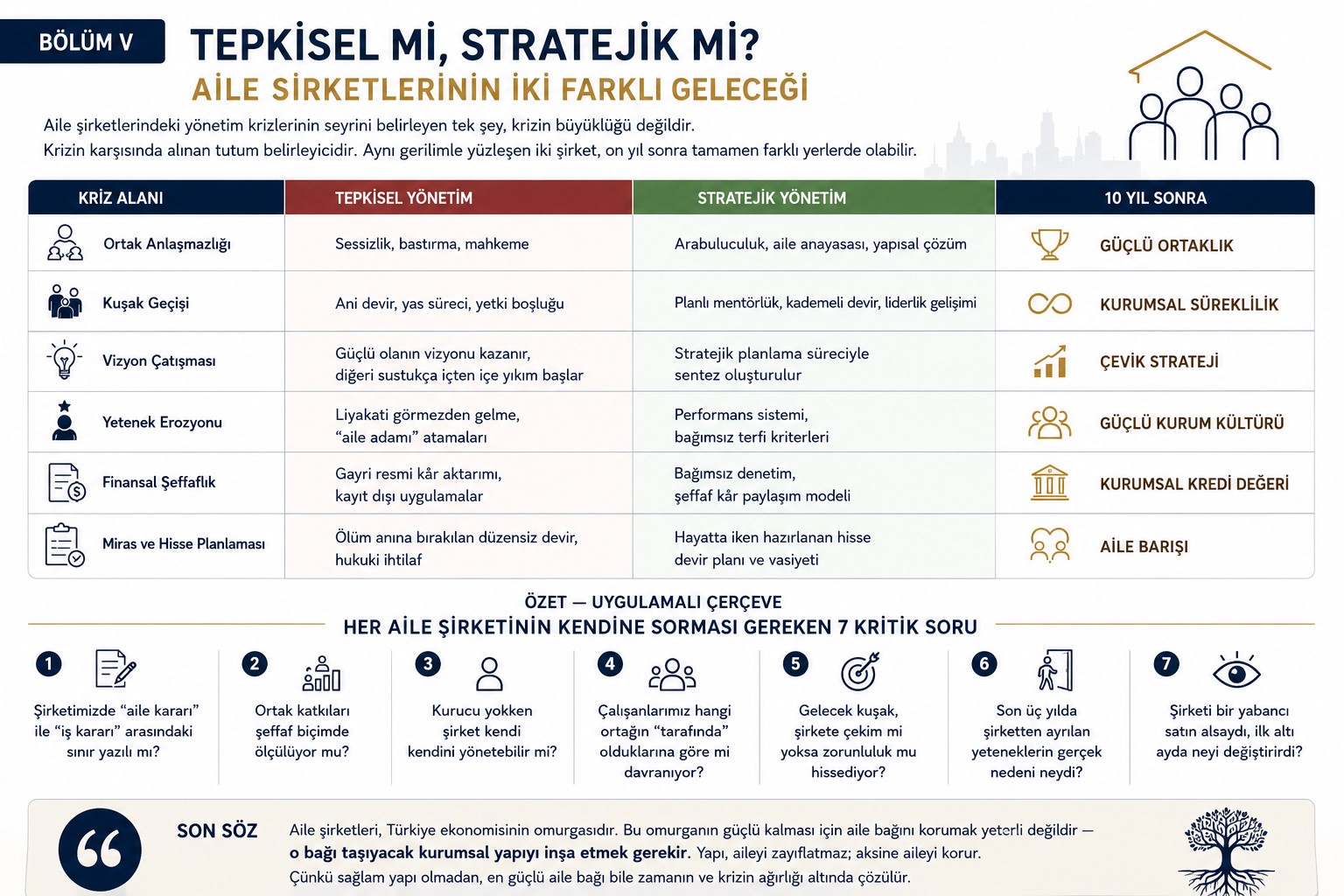
The course of governance crises in family businesses is not determined solely by the magnitude of the crisis. The approach taken in response to the crisis is decisive. Two companies facing the same tensions may find themselves in completely different positions ten years later.
|
Crisis Area |
Reactive Management |
Strategic Management |
10 Years Later |
|
Shareholder Disputes |
Silence, suppression, litigation |
Mediation, family constitution, structural resolution |
Strong Partnership |
|
Generational Transition |
Sudden transfer, grieving period, authority vacuum |
Planned mentoring, gradual transfer, leadership development |
Institutional Continuity |
|
Vision Conflict |
The stronger party's vision prevails; as the other remains silent, internal deterioration begins |
A synthesis is created through the strategic planning process |
Agile Strategy |
|
Talent Erosion |
Ignoring merit, appointing "family loyalists" |
Performance system, independent promotion criteria |
Strong Corporate Culture |
|
Financial Transparency |
Informal profit transfers, unrecorded practices |
Independent audit, transparent profit-sharing model |
Corporate Creditworthiness |
|
Inheritance and Shareholding Planning |
Disorderly transfers left until death, legal disputes |
Share transfer plan and will prepared during the owner's lifetime |
Family Harmony |
Summary — Applied Framework
7 Critical Questions Every Family Business Should Ask Itself
These questions are uncomfortable. They have to be uncomfortable — because real transformation begins outside the comfort zone.
1. Is the boundary between a "family decision" and a "business decision" documented in our company?
If it is not documented, every decision becomes an area of both personal and institutional tension. Drawing this boundary means institutionalizing integrity.
2. Are shareholder contributions measured transparently?
Equal shareholding does not mean equal contribution. When contribution is not made visible, resentment accumulates — and accumulated resentment is the real source of the most serious corporate crises.
3. Can the company manage itself without the founder?
If the answer is "no," then what exists is not an institution, but an individual. And individuals are mortal. You are planning the founder's retirement, not the institution's continuity.
4. Do our employees behave according to which shareholder's "side" they are on?
This question is one of the clearest signals of a spreading crisis. When employees begin taking sides, corporate identity has collapsed.
5. Does the next generation feel drawn to the company, or obligated to join it?
There can be no sustainable leadership in a company managed through a sense of obligation. The next generation's freedom to choose is the strongest source of genuine commitment.
6. What was the real reason talented employees left the company over the past three years?
Were exit interviews conducted? Were the responses analyzed? The real answer is often not "a better opportunity," but "I cannot grow here."
7. If an outsider acquired the company, what would they change in the first six months?
The answer to this question is your institutionalization roadmap. An external perspective immediately clarifies structural problems that cannot be seen from within.
Final Word
Family businesses are the backbone of the Turkish economy. To keep this backbone strong, preserving family bonds is not enough — it is necessary to build the institutional structure that can carry those bonds. Structure does not weaken the family; on the contrary, it protects it. Because without a solid structure, even the strongest family bond will eventually unravel under the weight of time and crisis.
Have a critical role to fill?
Share your role and we'll present a qualified shortlist within 5-10 business days.