Section III
The Spillover Map: How Does a Family Crisis Spread Across Departments?
One of the least understood dimensions of governance crises in family businesses is the spillover dynamic. Tension among shareholders does not remain confined to the boardroom; it spreads throughout the organization in waves. This spillover is often invisible — yet its consequences are highly tangible.
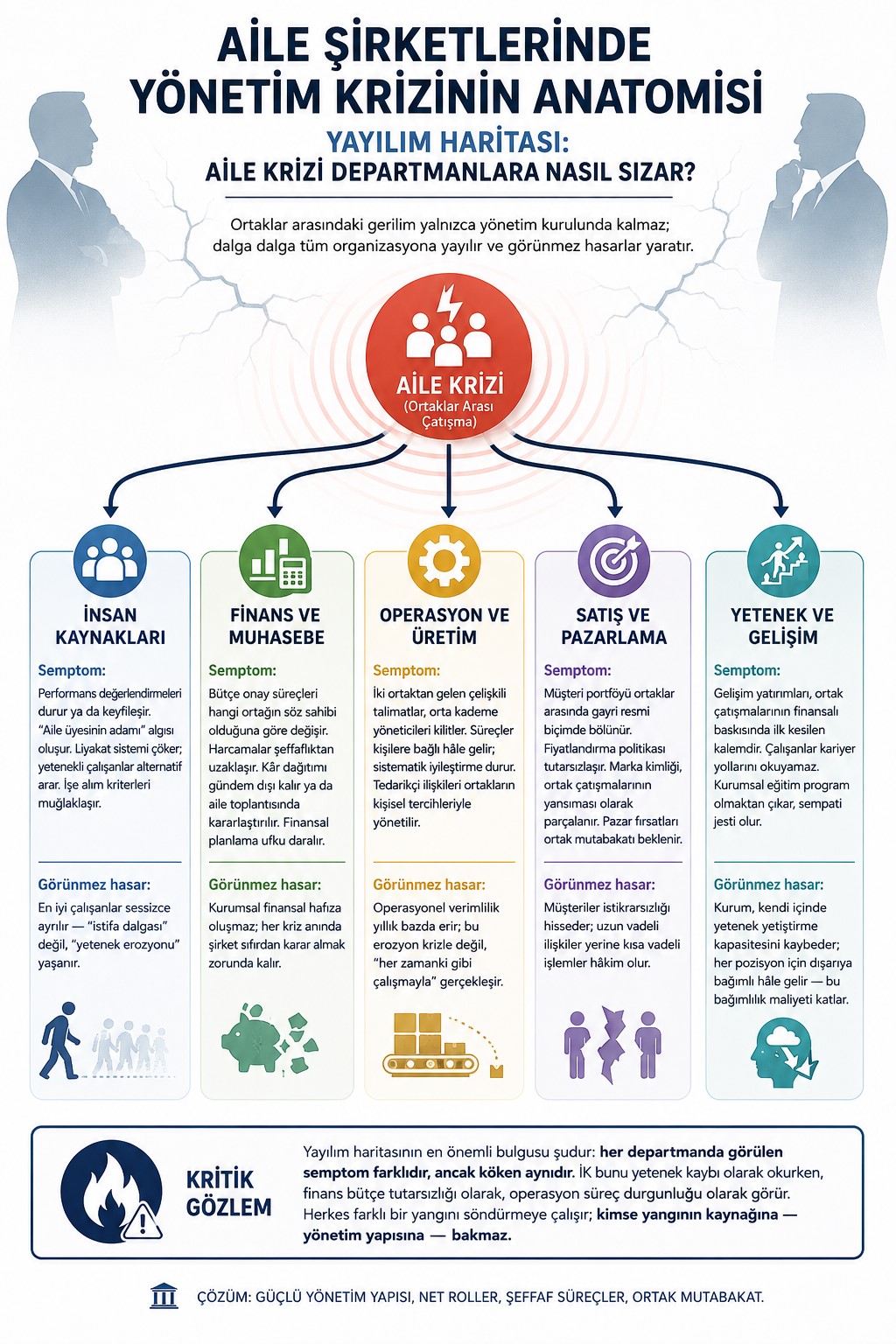
Department-Level Spillover Map — Shareholder Crisis → Organizational Impact
Human Resources
Symptom: Performance evaluations come to a halt or become arbitrary. A perception of being “the family member’s person” emerges. The merit-based system breaks down; talented employees begin looking for alternatives. Recruitment criteria become unclear.
Invisible damage: The best employees leave quietly — rather than a “wave of resignations,” the organization experiences “talent erosion.”
Finance and Accounting
Symptom: Budget approval processes change depending on which shareholder has greater influence. Expenditures become less transparent. Profit distribution is either removed from the formal agenda or decided during family meetings. The financial planning horizon becomes shorter.
Invisible damage: Institutional financial memory fails to develop; with every crisis, the company is forced to make decisions from scratch.
Operations and Production
Symptom: Conflicting instructions from two shareholders paralyze middle management. Processes become dependent on individuals, and systematic improvement comes to a halt. Supplier relationships are managed according to the shareholders’ personal preferences.
Invisible damage: Operational efficiency gradually deteriorates year after year; this erosion occurs not through a visible crisis, but through “business as usual.”
Sales and Marketing
Symptom: The customer portfolio is informally divided among shareholders. Pricing policies become inconsistent. Brand identity becomes fragmented as a reflection of shareholder conflicts. Market opportunities are put on hold while awaiting shareholder consensus.
Invisible damage: Customers sense the instability; short-term transactions begin to replace long-term relationships.
Talent and Development
Symptom: Development investments are among the first areas to be cut under the financial pressure created by shareholder conflicts. Employees can no longer see a clear career path. Corporate training ceases to function as a structured program and turns into a gesture of favoritism.
Invisible damage: The organization loses its internal capability to develop talent and becomes dependent on external recruitment for every position — significantly increasing costs.
Critical Observation
The most important finding of the spillover map is this: the symptoms observed in each department are different, but their root cause is the same. Human Resources interprets the problem as talent loss, Finance as budget inconsistency, and Operations as process stagnation. Everyone tries to put out a different fire; no one looks at the source of the fire — the governance structure.
Have a critical role to fill?
Share your role and we'll present a qualified shortlist within 5-10 business days.