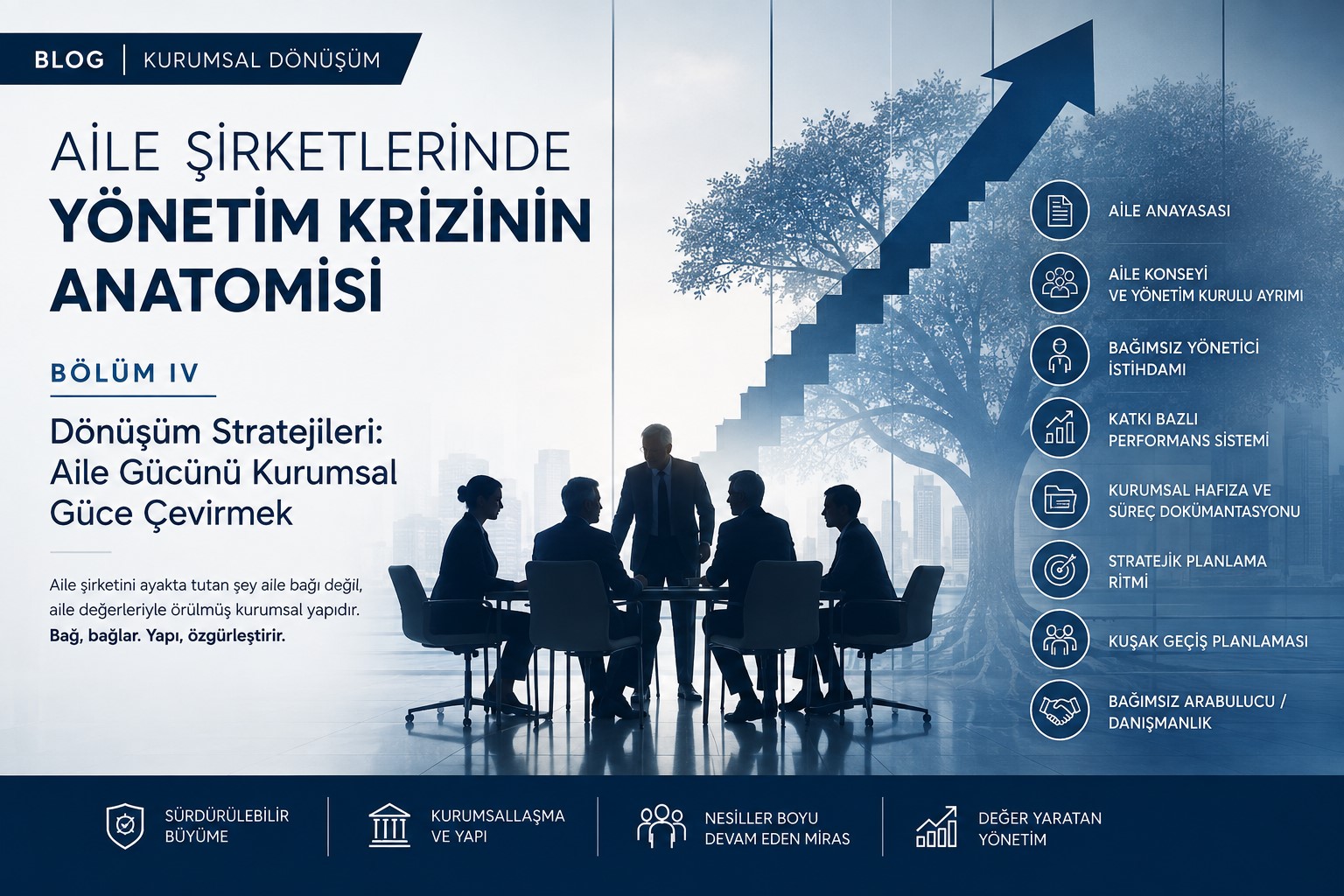
Family Businesses: The Anatomy of a Management Crisis
Part IV
Transformation Strategies: Turning Family Strength into Institutional Strength
When we examine family businesses that have succeeded in extending their corporate longevity, one common denominator stands out:
These companies have succeeded not by removing the family from the business, but by positioning the family within the right governance structure.
Management reform does not eliminate family values; on the contrary, it makes those values sustainable.
01 — Family Constitution
A family constitution is the fundamental document that formally defines the roles, rights, responsibilities, and boundaries of family members within the company.
A rule that is not written down is a rule that is not enforced.
A family constitution takes disagreements out of the personal sphere and places them within a framework of agreed rules.
02 — Separation of the Family Council and the Board of Directors
The Family Council manages family matters; the Board of Directors manages business matters.
Whenever these two structures become intertwined, the company risks making poor decisions on both family and business issues.
When a clear separation is established, both structures become stronger.
03 — Appointing Independent Professional Executives
An independent professional executive brought in from outside the company creates an objective point of reference, free from conflicts among family shareholders.
Family members begin discussing issues based on “the professional executive’s analysis” rather than “my sibling’s opinion.”
This distinction can fundamentally improve the quality of decision-making.
04 — Contribution-Based Performance System
Clear job descriptions, objectives, and performance criteria should be established for every family member and shareholder actively involved in the business.
Shareholding percentages may remain fixed; however, compensation and operational authority should vary according to contribution.
This distinction makes fairness visible and helps reduce resentment.
05 — Institutional Memory and Process Documentation
Decisions and the reasoning behind them should be documented. Processes should be tied to systems rather than individuals.
Knowledge should reside not in one person’s mind, but in the organization’s institutional memory.
This makes both generational transitions and changes within the family more manageable.
06 — Strategic Planning Rhythm
An annual strategic planning cycle moves differences in vision among family members away from personal tension and onto an institutional platform for discussion.
Different perspectives become options rather than sources of conflict.
The strategic plan creates common ground.
07 — Succession Planning
Succession should not be planned during a crisis; it should begin at least five years in advance.
The transfer of authority, knowledge, and leadership responsibilities should be managed through a structured development program.
Sudden transitions can turn into organizational trauma.
08 — Independent Mediation / Advisory Support
Before conflicts among family shareholders deepen, seeking independent corporate advisory or mediation support can serve as a critical protective mechanism.
An objective external perspective can reveal blind spots that family dynamics may prevent those inside the organization from seeing.
What keeps a family business alive is not the family bond itself, but an institutional structure built around family values.
Bonds bind. Structure liberates.
Have a critical role to fill?
Share your role and we'll present a qualified shortlist within 5-10 business days.